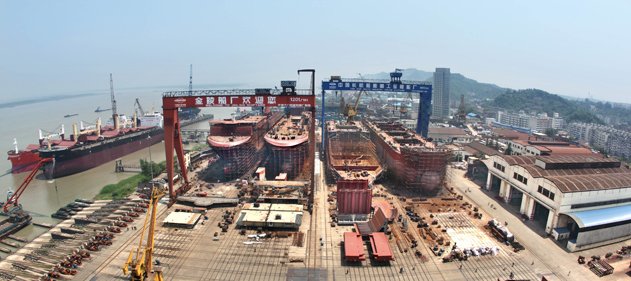
Right from the outset of the Titanic II project in 2012, Billionaire Clive Palmer stated that his vessel, a replica of the original 1912 RMS Titanic, would be built in China’s Jingling shipyard. (Although this has NOT been confirmed).
The original RMS Titanic was built at the ‘Harland and Wolff’ shipyard in Belfast, Northern Ireland. Although the company still exist, they no longer build big passenger ships. many modern cruise ships are built in European ship yards.
In contrast, CSC Jinling Shipyard is a state-owned ship building company located in Jiangsu, China. It was founded in 1952.
Jinling Shipyard’s Nanjing (82 acres) and Yizheng (220 acres) yards spread along 2 miles of shoreline. Exports started in 1996, since when Jinling has exported about 200 vessels to over 30 countries. Over 900 staff are employed. There are two dry docks up to 200,000 DWT, 8 50,000 DWT slipways, 3 fitting-out piers and 9 heavy lifting cranes with capacities of up to 500 tons. (Wikipedia)
Jinling is an interesting (brave?) choice by Palmer, as Jinling have NEVER built a large luxury cruise ship before. However Jinling does build lots of Ferries, Cargo ships and even Submarines. I believe that they have also build passenger boats for the Yangtze river too
The biggest shipbuilding nations in the world are South Korea, Japan, China and Russia. However most of today’s cruise ships are built in Europe: Germany, France, Italy or Finland. The construction of cruise ships is a specialist niche market, although an increasingly big ‘niche’.
Can Jinling Actually Build Titanic II?
I’m NOT a shipbuilding expert, so I’m speculating here: but I assume that Jinling would not have a problem building Titanic II’s hull, as it will NOT be riveted, like the original Titanic’s hull was, it will be welded – the modern method. I assume that it will not be so much different from building any Ferry or cargo ships hull, although it will be a unique shape.
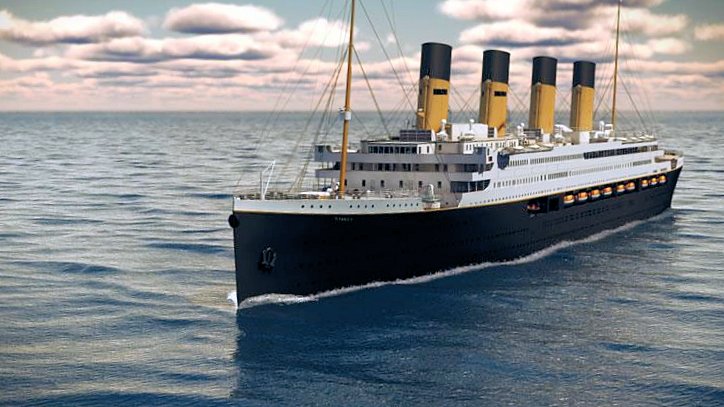
I assume that Jinling will have no problem installing the technical equipment and machinery: generators, engines, pods and bridge navigation equipment and lifeboats etc. Cargo ships and ferries have all of these too, of course.
shipyards dedicated to mainly building cruise ships, have the cabins constructed off-site, in a factory and they are transported to the shipyard. The cabins are then slotted into the hull for speed and a significant cost saving. Are Jinling geared up to do this, on this scale?
I also assume that the Titanic II’s lavish décor in the dining rooms and other public rooms, would require specialist skilled workers. Does Jinling have access to such skills?
Even the Titanic II’s more ornate superstructure that most modern ships, might be a challenge for Jinling to recreate? (In fairness, any shipyard may find re-creating the décor and aesthetics of a 1912 Ocean Liner a challenge).
Titanic II is not a big ship by modern standards, at around 56,000 gross tonnes and 237 meters in length. However this may be towards their upper limit, but I believe they have constructed Ferries around this size.
Jingling does have an impressive record of 100% of their ships have been delivered on time.
In Conclusion
I believe Palmer did have a very good relationship with Jinling as they have built cargo ships, for his mining ventures. China is also said to be keen to prove to the world that they can build cruise ships. The Titanic II would be a great show-case for them to get into this lucrative market.
Maybe Palmer expected to get a bargain price for building Titanic II because of these factors? However his relationship with China may have soured a little, in recent years due to his business ‘tensions’?
Alternatively the European shipyards are better geared-up for this task. They have a long and proven track record building numerous modern and complex ships passenger ships, some of which were in a retro-style. For example: Cunard have had three of these built in Europe (Queen Victoria, Queen Elisabeth and the Queen Mary 2 Ocean Liner) and a fourth one planned.
It will be interesting to see if Palmer really does pick the Jinling shipyard, at the end of the day.
Malcolm
Update:
Deltamarin, the Finnish ship designers, who are actually designing the Titanic II said: “The shipyard has not yet been selected. After completing the outline design we will search for suitable shipyards for this project around the world and together with the owner select the ones requests for quotation will be sent to. After quotations are received the final building yard will be selected”.
June 2023: China Can Build Cruise Ships!
At the very start of the Titanic II project in 2012, project mastermind Clive Palmer said that his replica Titanic would be built in China’s state owned Jinling shipyard.
Although China is a major builder of cargo ships and have actually build some for Palmer’s coal and iron ore businesses, they do not generally build cruise ships. This made many commentators rather sceptical about Palmers’ choice of shipyard. However China are very keen to enter into the lucrative cruise ship construction business.
However, all the above has now changed:
Adora Cruises, the Adora Magic City was floated out last week. The vessel is now undergoing a six-day undocking operation that includes a series of trials and equipment testing. The ship is then set to depart on its first set of sea trials in July.
With the the 135,000 gross tonne vessel Adora Magic City now floating, the hull doors and portholes were tested for their sealing capabilities.
In final stages of construction at the Waigaoqiao Shipbuilding Yard in Shanghai, the Adora Magic City is scheduled to be delivered before the end of 2023.
The first large cruise ship ever built in China, the newbuild will be operated by Adora Cruises, who plans to deploy it on a series of domestic and international itineraries departing from the Port of Shanghai.
A joint venture between Carnival Corporation and China State Shipbuilding Corporation (CSSC), the Adora brand was launched in late 2022.
(CIN)
 Titanic II News