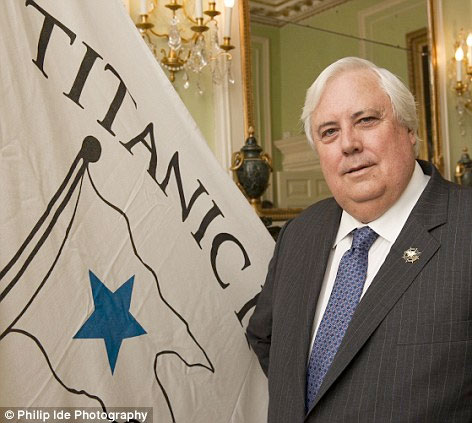
Australian Billionaire, Clive Palmer, has resurrected his plan to build a replica of the ill-fated Titanic.
Mr Palmer, released a statement in September 2018, as chairman of Blue Star Line, saying the company had recommenced work to build Titanic II to operate on the London to New York route.
Mr Palmer said work on the Titanic II project was suspended in 2015 because his flagship company Mineralogy was in dispute with Chinese government-owned Citic over the payment of hundreds of millions of dollars in royalties to Palmer companies.
Tank Test
(Click bottom right to watch larger version on YouTube)
In September 2013 a model of the Titanic’s hull was tested in Hamburg, Germany (see video above).
Blue Star Lines statement read:
Palmer said: “Our team lead by Deltamarin in Finland have been very busy over the past few month working to finalise plans for the ship to begin construction. Working with German hydrodynamic service and consulting company Hamburg Ship Model Basin (HSVA) we have conducted the first model testing of the proposed Titanic II.
“The model testing by HSVA, including resistance and open water tests, is an important part of the process in the Titanic II project,”
“The Titanic II model was tested by HSVA at speeds of up to 23 knots and this testing is crucial for assessing the speed and power performance of this prototype vessel design.
“Blue Star Line was represented at the tests by the World Project Director of Titanic II, Baljeet Singh. We look forward to receiving the results later this year.”
HSVA Director of Resistance and Propulsion, Dr Uwe Hollenbach, said HSVA was delighted to be part of the historic Titanic II project.
“The Titanic II model was given the HSVA model number 5000,” Dr Hollenbach said.
“In honour of Titanic II and Blue Star Line, we also held a naming ceremony and launched the model on a traditional slipway.”

Dr Hollenbach said model testing was the only accurate and reliable method for a passenger vessel prototype such as Titanic II.
“Titanic II is a prototype as present day passenger vessels have a completely different type of main hull parameters and therefore are unsuitable as references,” Dr Hollenbach said.
“The speed and power performance model testing is one of the critical aspects for a prototype vessel and needs to be verified before a construction contract is completed”.
“Self propulsion tests determine the optimal sense of wing propeller rotation, the neutral wing thruster angle and optimal load distribution between wing and centre units.”
“Our team lead by Deltamarin in Finland have been very busy over the past few month working to finalise plans for the ship to begin construction. Working with German hydrodynamic service and consulting company Hamburg Ship Model Basin (HSVA) we have conducted the first model testing of the proposed Titanic II.

The 9.3m wooden model of Titanic II has be put through resistance and powering tests in a 300m long tank at HSVA’s Hamburg facilities in mid-September. We are extremely excited about finalising this testing and means we can move on with finalising our construction contract”.
Propulsion
Titanic II will have modern engines diesel/electric engines. You can see from the image above that the hull will have three ‘Azipods’ (image above coloured blue) with propellers, that pull the ship through the water, rather than pushing it.
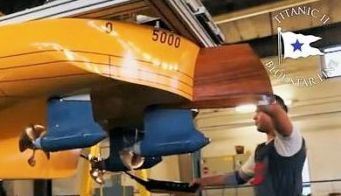
The tank test model (see photo above) had functioning ‘Azipods’, so accurately simulate Titanic II’s performance.
The rendering below provides a better view of the three Azipods.
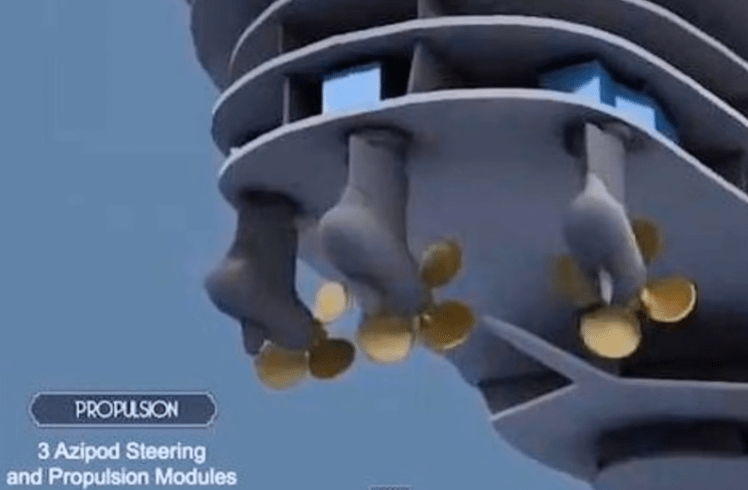
These pods can rotate 360 degrees making the ship very manoeuvrable so much more manoeuvrable than the original*.

A rudder is not required. However a rudder for cosmetic reasons, extending to the water level (and not much below) can be seen in the rendering above.
In the image below, part of the rudder has been re-create on the aft of the tank test model below (brown).
I have a separate page about Titanic II’s propulsion – HERE
Malcolm
*Would the original Titanic have been able to steer clear of the iceberg in time, if she had the Pod technology? Who knows?
 Titanic II News