.
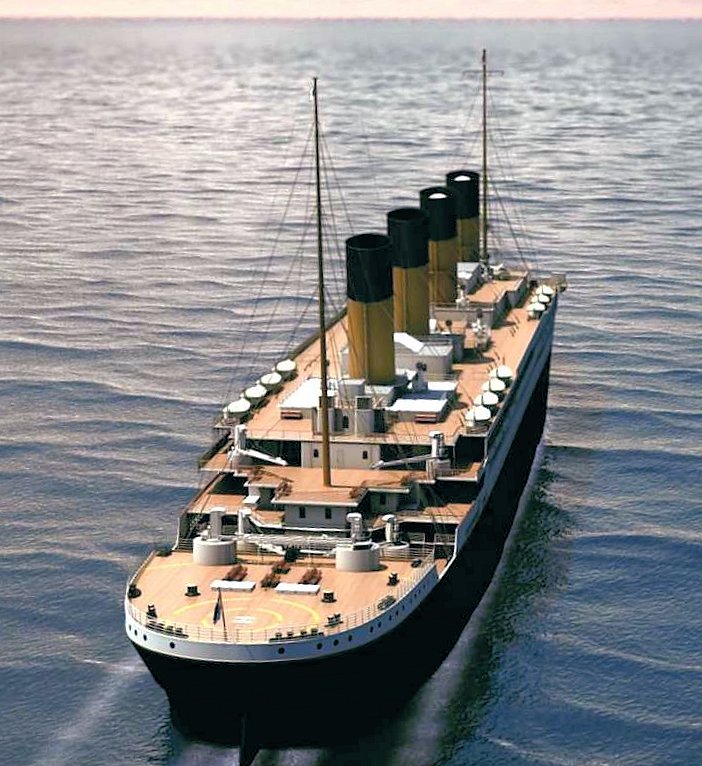
So will Clive Palmer’s modern ‘replica’ of the Titanic be an ‘Ocean Liner’ or a ‘Cruise Ship’?
We don’t have a full Titanic II specification yet, so I’m going to speculate, somewhat:
Although the terms ‘Cruise Ship’ and ‘Ocean Liner’ are sometimes used interchangeably, they have very different meanings. (The term ‘Cruise Liner’ is a mixture of both terms and has no real meaning apart from a ship carrying people on holiday.)
Originally Ocean Liners were the only form of intercontinental transport. They pre-date the development of aeroplanes that could fly long-haul.
An Ocean liner was designed to transport passengers from A to B (called a line voyage), such as Southampton to New York, safely and as fast as possible. Ocean Liners in the golden age typically took 4-5 nights to cross the Atlantic, although the SS United States holds the record (1952, 3 days, 10 hours, averaging 35.5 knots).
Because Ocean Liners operated all year round and could encounter very severe winter seas, their hulls were extra strong. Their bows were slender in order to cut through the waves. Their drafts were deep for stability. They were also built for speed in order to make the crossings as fast as possible. They also had large amounts of storage spaces for food, water and coal, needed for their longer line journeys, with no ports of call, for days at a time.
In contrast, Cruise Ships are a more modern invention. They often perform round trips (Miami to Miami, for example) and cruise at more moderate speeds. They often visit a number of ports of call per journey, such as the Caribbean islands. They often cruise in warm waters and favourable sea conditions. The ships are built for passenger comfort rather than endurance or speed. They are built for ‘holidays’, they are no longer a method of ‘transport’. They can re-fuel and re-load provisions every few days, if required, so require less storage space.
Modern cruise ships have lots of glass, balconies and leisure facilities, such as on-deck swimming pools. There hulls are not specifically designed for the rigours of the North Atlantic in the winter, or similar challenging sea conditions.
The Original RMS Titanic
The original RMS Titanic (1912) was obviously constructed as an ‘Ocean Liner’, specifically for the Southampton to New York transatlantic crossings and return. Although she was not particularly fast (23 knots) that was probably the limits of steam propulsion technology at the time. Her hull was constructed to be very strong to protect it from damage, from rough seas. She had a pretty deep draft of 10m, for the size of ship. This was to provide increased stability.
Computer simulations and water tank tests were carried out on a model of the Titanic II’s hull in 2013. Interestingly, they revealed that the RMS Titanic’s original hull design is not stable enough to meet modern maritime regulations. The original designers, of course, did not have the benefit of modern technology when designing the hull.
Titanic II’s hull will be 2m wider in the beam and have a reduced draft, when compared to the original. She may also have a bulbous bow to increase fuel efficiency (to be confirmed).
A Modern Ocean Liner
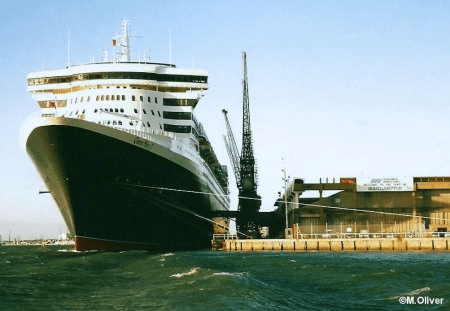
The only modern Ocean Liner is the wonderful Cunard ‘Queen Mary 2’ (2004). She is around 150,000 gross tonnes (a measurement of internal volume, not space). The Titanic II will be small by modern passenger ship standards, at an estimated 56,000 gt. In general the bigger the ship, the better seakeeping abilities (stability) it has.
In fairness, in the early 1900’s Ocean liner’s were small. let’s not forget that in 1912, Titanic and her two sisters were the biggest ships afloat.
QM2 was built for North Atlantic crossings and has a very thick/strong hull. However this added 50% to the construction costs. She also has a high navigational bridge and a high bow, with a breakwater on it, to protect the bridge from damage from big waves.
Even the QM2’s lifeboats are located higher than on-board conventional cruise ships, of a similar size. This is also to protect them from being damaged by rough seas. The rendering below shows the Queen Mary 2’s (left) lifeboat placement, compared to ‘Oasis of the Seas’ (right).
As proof of concept: When ‘Oasis’ did her maiden crossing in 2009, from the shipyard in Finland, to Miami, the December seas were pretty rough. She arrived with two damaged lifeboats.

The QM2 of course also has ample storage space for fuel, water and food etc. her longer ‘line’ voyages.
The Titanic II bridge will be higher than the original, relative to the bow, as the superstructure has been raised by 1.3 metres. This negates the requirement on the original Titanic for lookouts. However It will not be as high as the QM2’s, so I doubt that it will be as well protected.
I’m speculating here, but I’d be surprised if Titanic II will have an extra-thick hull. This would be very expensive to construct. Her lifeboats, on her ‘Safety Deck’, will be much lower to the sea, than the QM2’s, given the fact that the Titanic II will be so much smaller. Although I do note that the lifeboats are quite well shielded by the safety deck. On many other cruise ships (including Oasis) they protrude from the sides of the ship, so are exposed a little to the elements.
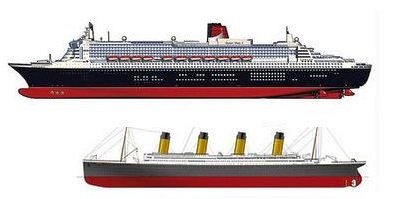
There should be plenty of room in Titanic’s hull for storage, as her modern engines/generators will take up a lot less space that Titanic original coal/steam engines and boilers.
In terms of speed, Titanic II’s modern modern diesel-electric engines will give her a maximum speed of about the same as the original RMS titanic, of 24 knots. This is 27.6 miles per hour.
In contrast the Queen Mary 2 can achieve 30 plus knots. This is 34.5 miles per hour.
If the Queen Mary 2 gets delayed by poor sea conditions, she can slow down for passenger comfort and later make up the speed, to fulfil her schedule.
However, the Titanic II will not have much speed in reserve, to create this flexibility.
The QM2 normally crosses the Atlantic in seven nights, but she can do it much faster (4-5 days). They slowed her down a few years back, to save fuel. Nobody crossing the Atlantic these days by ship, is in a hurry. The Titanic II, at 23 knots, will probably also take seven nights, but at her fastest.
In Conclusion
I am not sure that the Titanic II will technically be a ‘real’ Ocean Liner. I believe that she might just be a retro-looking ‘cruise ship’, just like Cunard’s Queen Victoria or Queen Elizabeth.
I don’t think we will see Titanic II travelling right across the middle of the Atlantic, in the winter months, like the ‘Queen Mary 2′ does, very regularly. Her size, strength and speed might not be up to it.
However I may be proved wrong?
Malcolm
2020 Update: I have now contacted ‘Deltamarin‘, the ‘Blue Star Lines’ chosen navel architect, on this subject. They are designing the Titanic II.
They have confirmed to me that: “Titanic II will be an ocean liner”. Well they should know!
However I have no further details exactly what her capabilities will be. I must admit that I am not entirely convinced, as yet.
Malcolm
Read my Queen Mary 2 Review: HERE
 Titanic II News